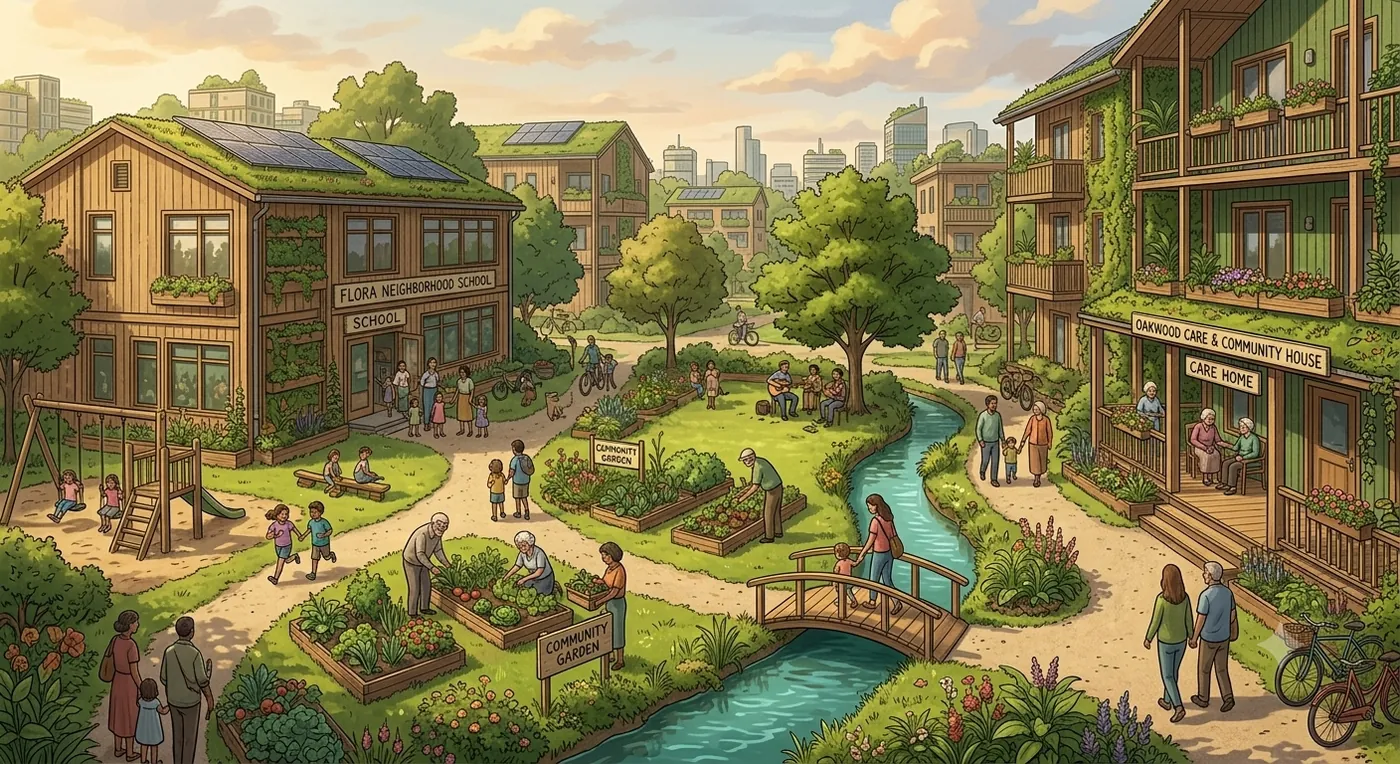
The city handles care, education and safety not with heavy institutions but with its own design. A floor instead of a gate, community instead of bureaucracy.
The healthiest thing about this city is its design: everyone cycles, walks, sits in the green and knows the neighbours. Loneliness is one of the biggest health risks there is, and the hamlet with a social heart fights exactly that. On top of that come a GP post per ring, a hospital in the centre, and specialist care in whichever city excels at it. Because your house is yours for life, care comes to people as they grow old, and informal care by neighbours and family simply counts as contribution.
A small school in every hamlet, so children cycle there safely on their own, something a car-free city suddenly makes ordinary. And no early sorting: an eleven-year-old truly does not know yet what they want to become. One broad school until about fifteen, built around project-based learning, so you discover what interests you by doing. Only then come directions, along paths that always stay open.
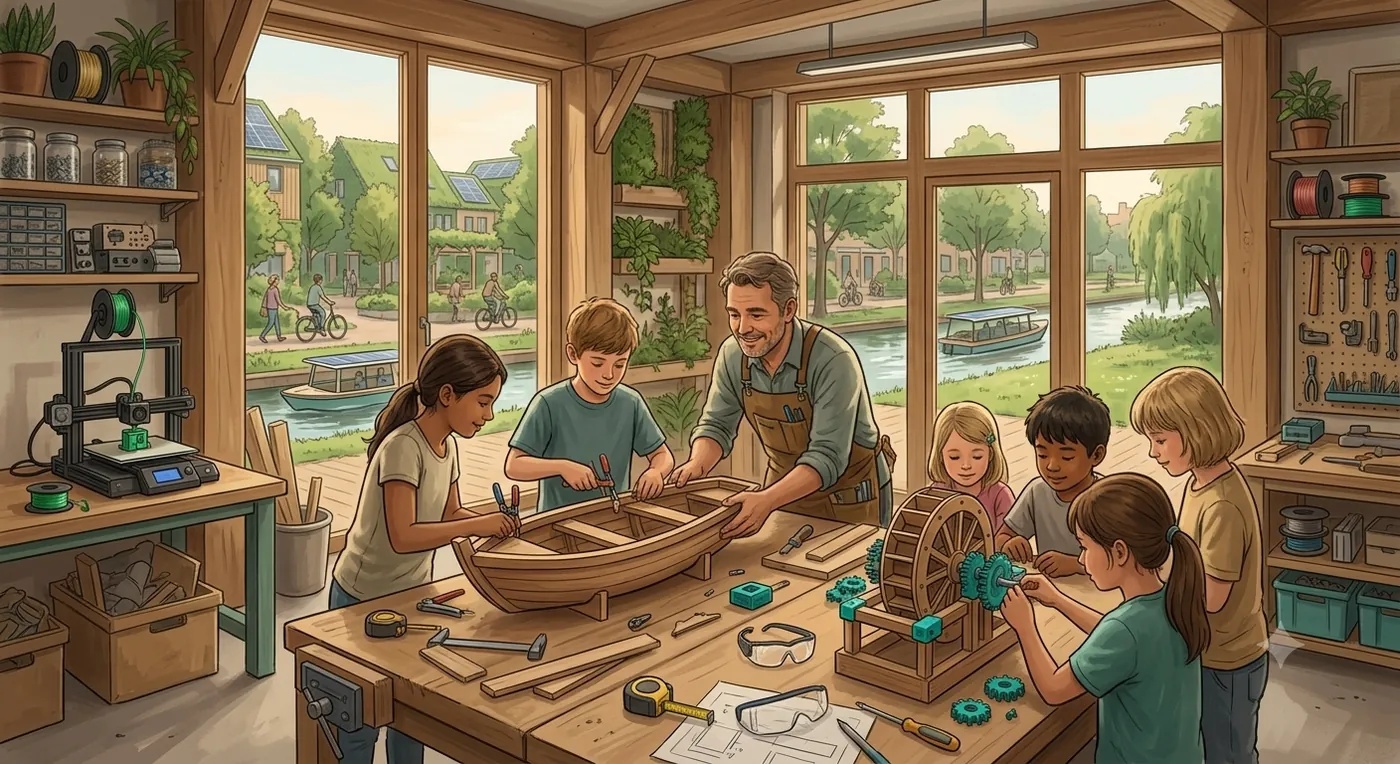
The shared workshops in the hamlets double as places to learn, where you work with your hands alongside the books. Education is a floor, free and for everyone, not a gate you open with credits.
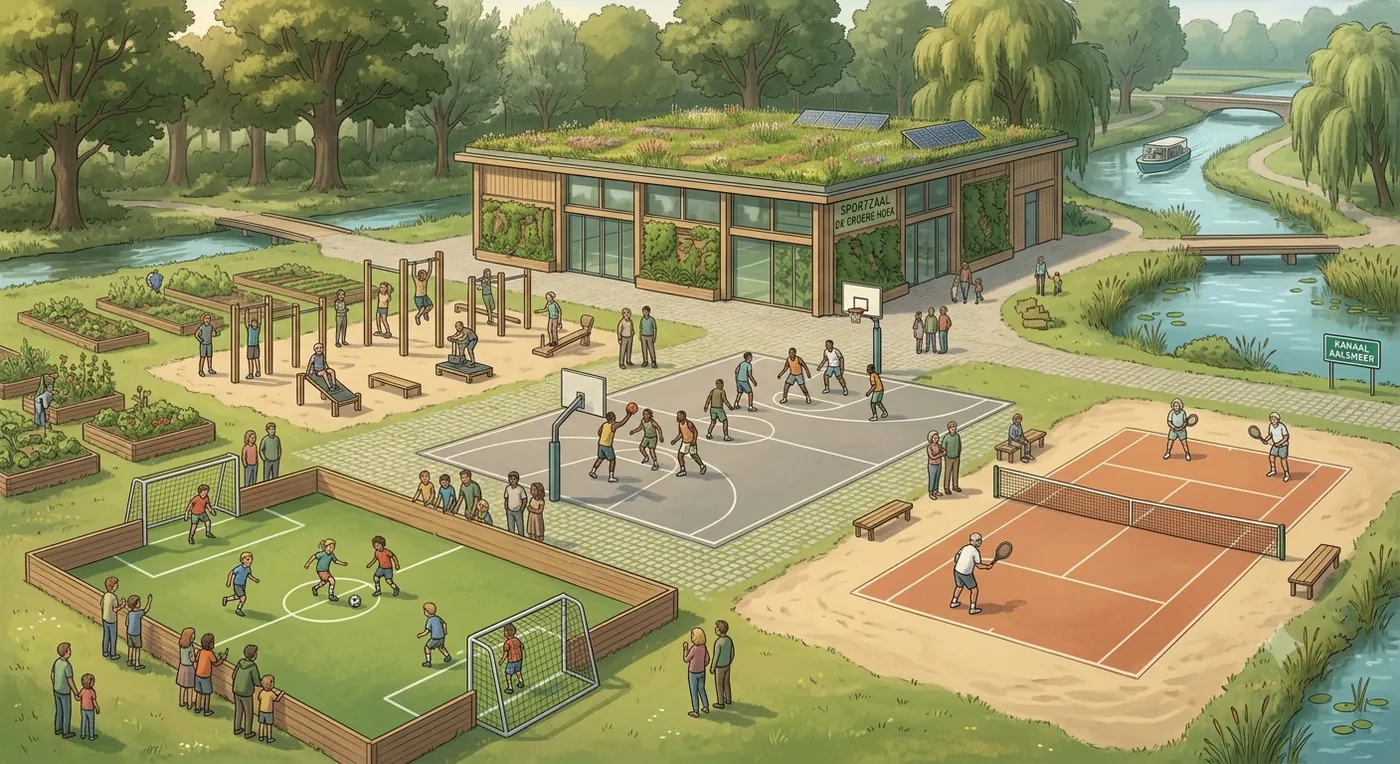
All the standard sports are simply there, spread out like the rest of the city. Every hamlet heart has a gym, a small pitch and a basketball court. Each ring has its sports hall, full-size fields and fitness. The centre holds the stadium and the main sports hall for competitions and events. And the engine underneath: trainers, coaches and youth leaders earn credits for their effort, so clubs flourish instead of greying out.
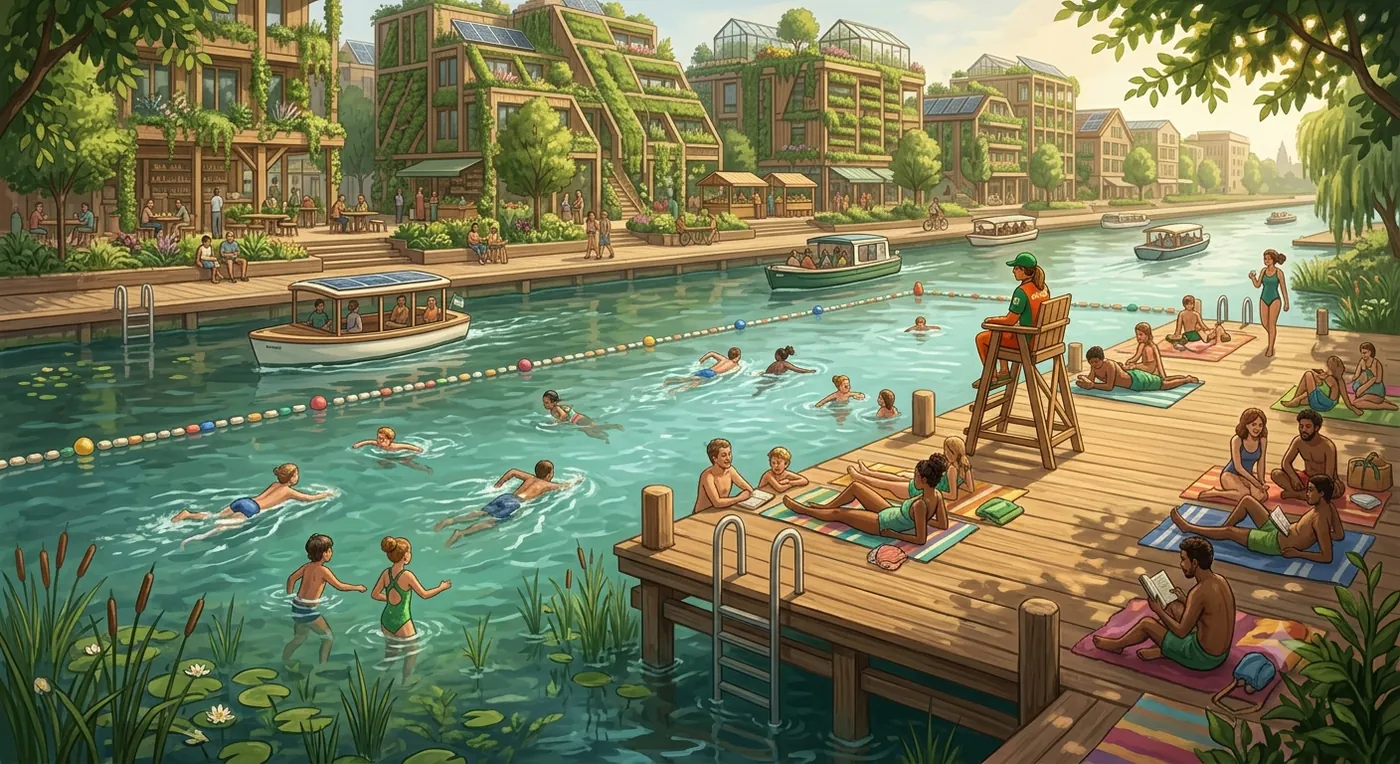
But the signature sport of this city is swimming. A city that lives on water should live in it too, and a city full of canals with residents who cannot swim is simply dangerous. Swimming lessons are therefore free for every child, all the way to their diploma. Being able to swim is basic safety here, as fundamental as learning to ride a bike.
And the best part: swimming in the canal is truly possible here. Old cities have dirty canal water because the sewer overflows into it during downpours; here rainwater and sewage are fully separated from the first day of construction, and the water cycle keeps the water clean. Copenhagen has been proving it works for years with its harbour baths. Designated swimming zones sit apart from the boat lanes, with jetties and steps, and the water quality is live on the public city dashboard.
Beyond that: natural swimming ponds in the parks, a city beach at the big lake in the greenbelt, and water playgrounds for the little ones. The canal network doubles as a route for canoe, paddleboard and rowing boat. Steps and climbing edges line every quay, also for whoever falls in by accident. And in a hard winter the same canals become skating rinks: the city that swims in summer skates in winter.
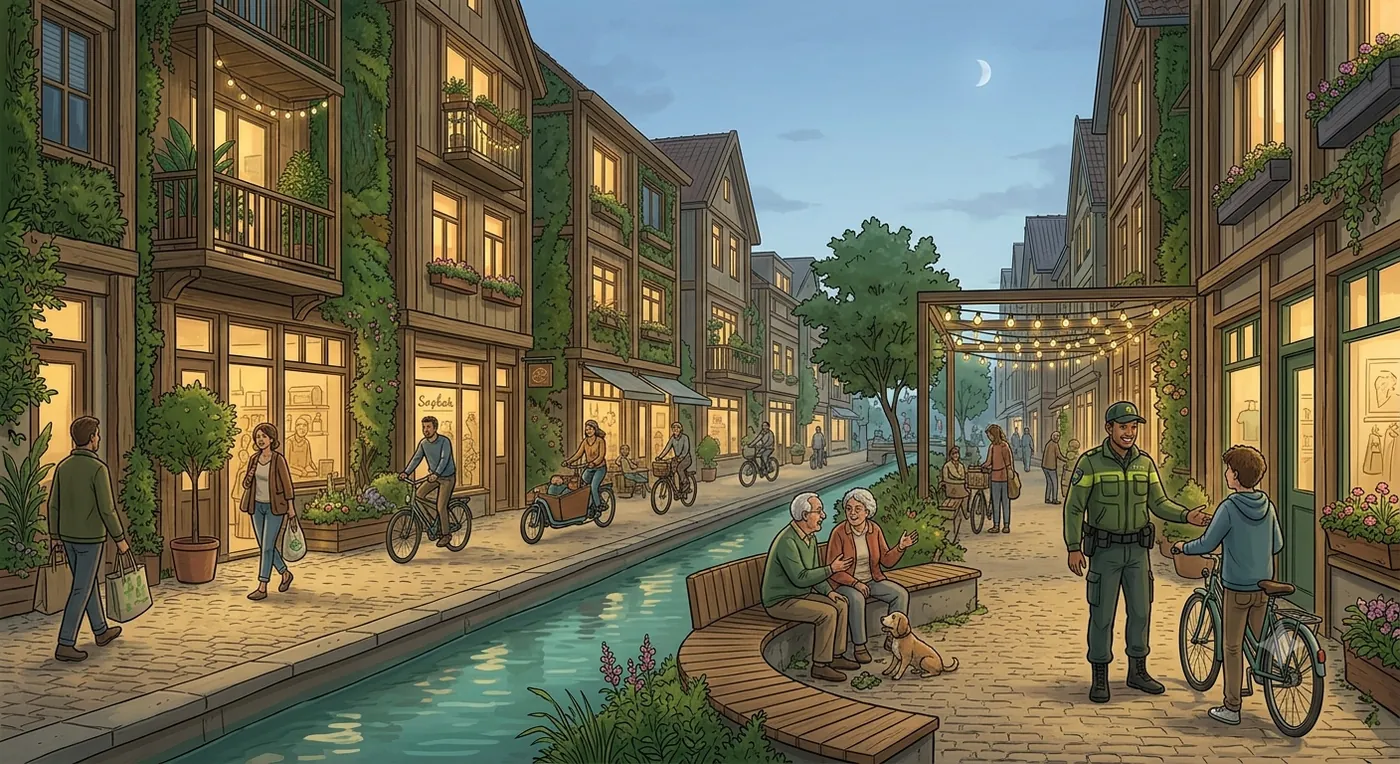
A safe city is easy to build as a police state, with cameras everywhere. That collides head-on with the promise that the resident stays private, so we choose the opposite. Lively, mixed, well-lit streets full of people watch over themselves, and in a hamlet where people know each other, you are safe because you are known. The face of that is the familiar neighbourhood officer everyone knows, not an invisible service. And the deepest measure is already taken: a city without a poverty trap removes the despair that feeds crime elsewhere. Security of existence is safety.
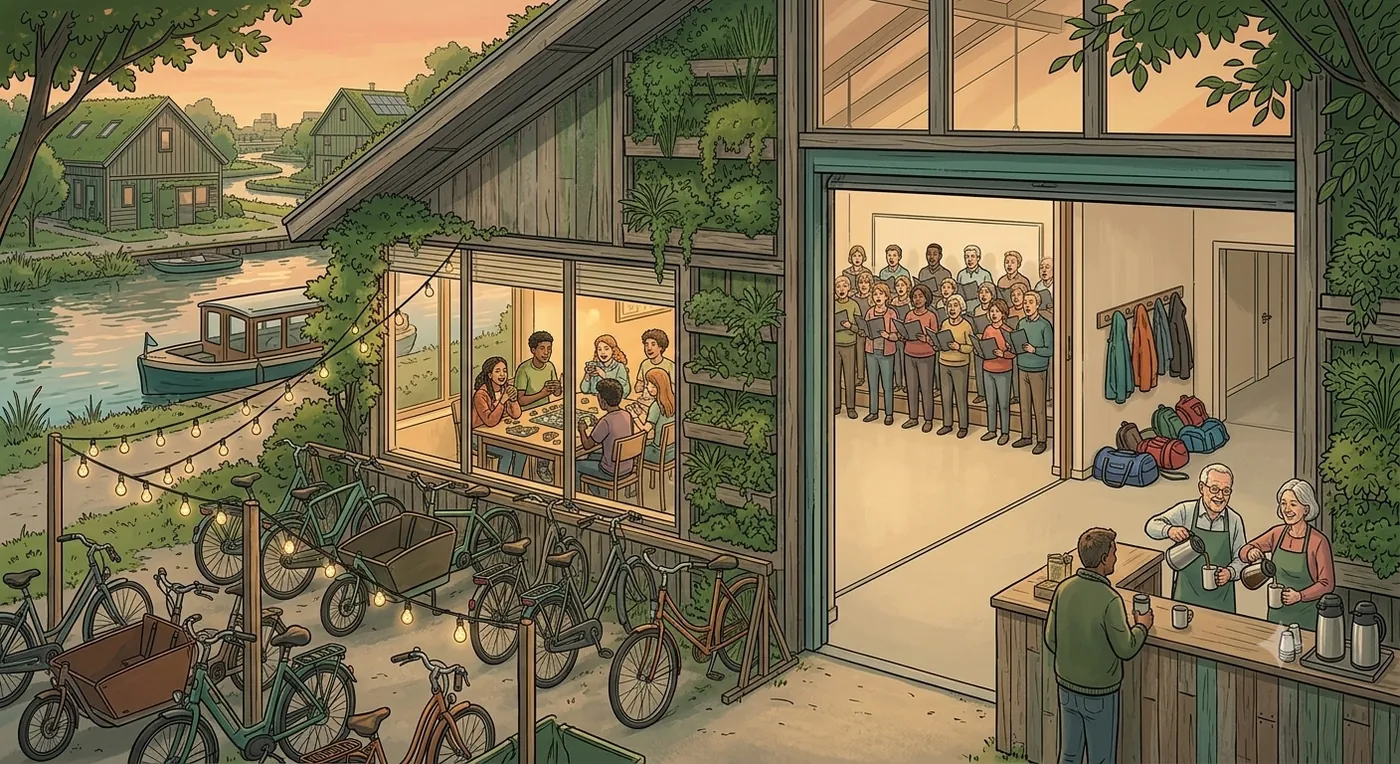
In our world, club life is dying a quiet death because nobody wants to be treasurer, coach or youth leader anymore. Here that work is simply contribution to the city, and it earns credits. The city structurally keeps the glue that falls away elsewhere. Every club, choir and faith community has a place in the hamlet's heart.
And for families the city works without a single family policy attached. Children cycle to school and to friends on their own, something modern cities lost. Neighbours keep an eye out, grandparents live around the corner, and whoever cares for a child or a parent is recognised for it instead of punished economically.
And if you would rather be left alone? Fine too. The anonymous, buzzing centre for those who want it, the close-knit hamlet for those seeking community. Community is offered here, never imposed.
And no city stands alone. Together they form a network, each equal, each with its own character.
To The network