Future Cities
NL
Housing, ownership & credits

You earn your place with what you contribute

Here your effort for the community decides how you live, not your bank balance. Your house is yours, the city belongs to everyone together, and nobody falls through the cracks.

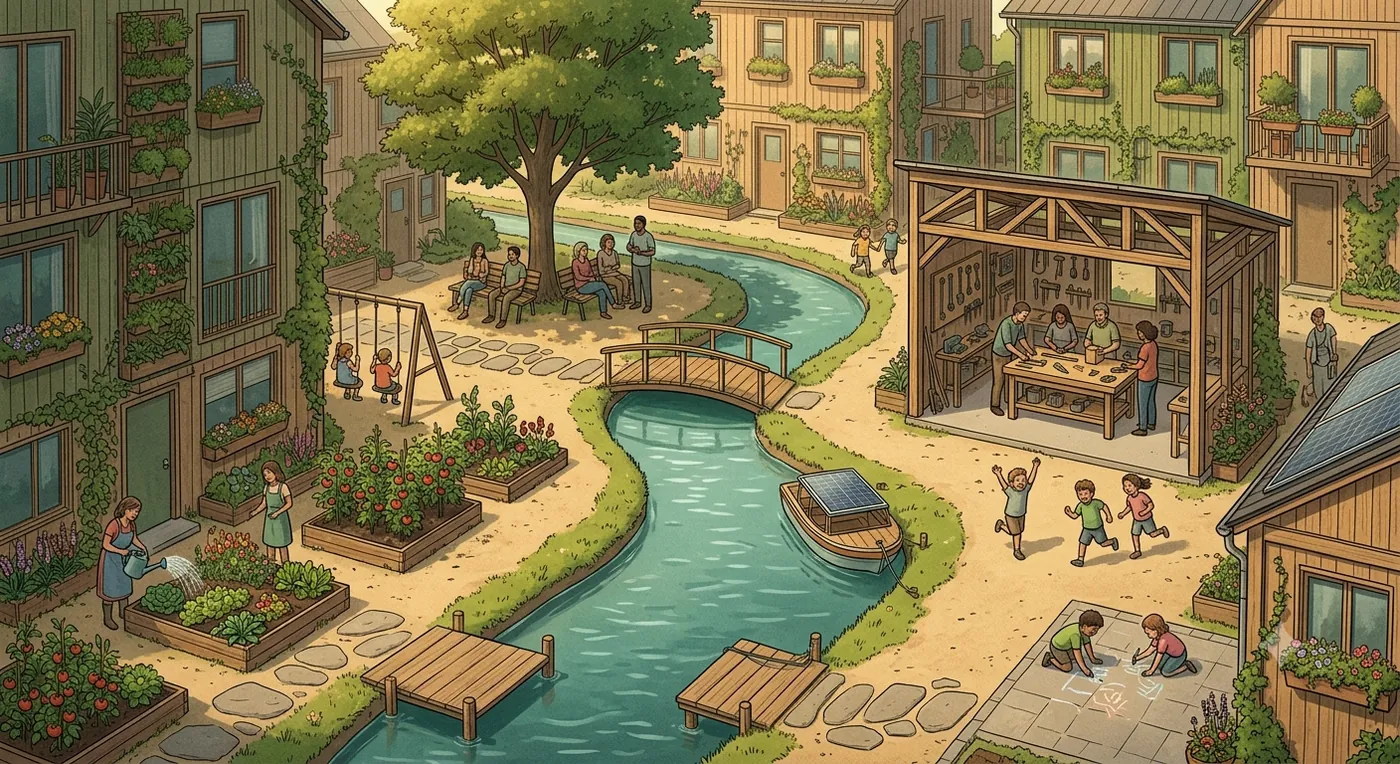
Neighbourhood square with allotments, a workshop and neighbours
Land shared, house yours

The land stays with the community, the bricks are yours

One body permanently owns all the land, and it is never sold. But your house you simply buy, and it is truly yours: you can rebuild it, sell it on and leave it to your children. So you are not renting. In the Netherlands this model is known as leasehold on community land.

Because the land stays collective, the sale of homes comes with ground rules, such as a resale price that rises with inflation but not with speculation. You build wealth, but nobody can buy up the city or send prices through the roof. The city stays affordable and mixed, generation after generation.

Governance

One body, democratically run

That one body keeps hold of the land, the infrastructure and the big plan, so the city stays coherent. But it does not stand above the residents, it belongs to them: a cooperative or trust in which everyone has one vote. One steward and a real democracy, no contradiction. That is the deliberate opposite of the company towns of the past, which looked physically perfect but where people could never take root because they owned nothing and had no say.

Credits

Effort that earns you a nicer place

Credits do not buy a roof over your head, they buy better. You save them by contributing to the city, and spend them on priority for the scarce, desirable homes: bigger, better located, a private garden. Effort decides who comes first, not wealth.

Just as important is what credits are not. You cannot buy them and you cannot sell them. If you could, you would have reinvented money. Ordinary money still exists for the plentiful, a coffee or a coat, but the scarce, housing and location, runs on credits that money cannot reach.

The life path across the city: you grow up with your parents in the outer ring, move to the lively centre as a young adult, build up credits there, and earn your way back out to a larger house with a garden. The young in the heart, families in the green ring, and credits as the engine that moves you outward and upward through life.

But that is a pattern, not a track you are forced onto. You may spend your whole life in the outer ring, or never leave the centre. Families can grow in the heart too, because every ring has a mix of home sizes and the car-free centre is a delight for children. A decent family home is available everywhere; only the finest spots are something to earn.
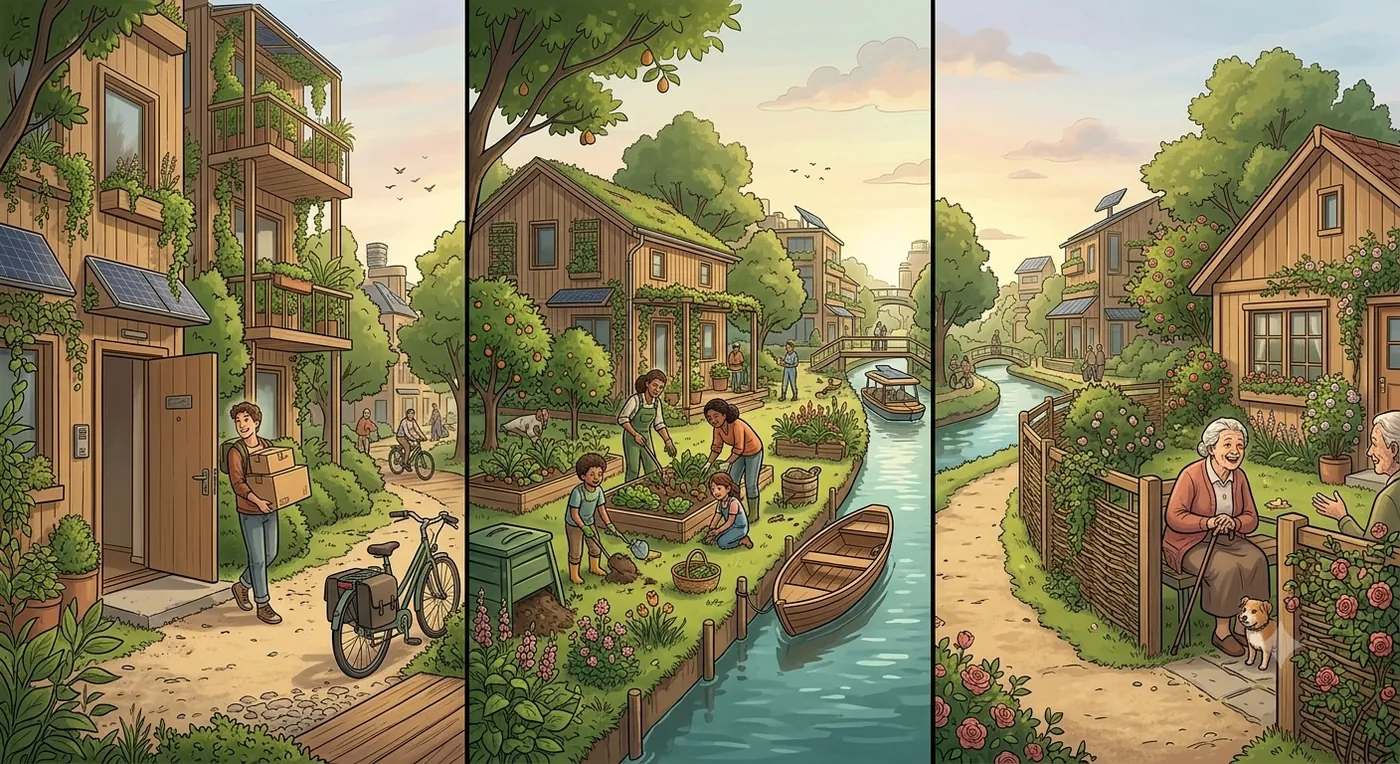
Life stages in one street: a starter with moving boxes, a family in the garden and an older neighbour over the fence
Inheritance & generations

The place is not inherited for free

A house is two things: its value (which you inherit as normal) and its scarce place (which is not free). When someone dies, the heirs choose: cover the place with their own credits and keep the family home, or cash out the value while the coveted spot returns to the pool. Humane, because you can keep the house you grew up in if you have earned such a place, and fair, because nobody occupies a villa with a view on zero effort.

Every generation starts at zero credits, so no hereditary upper class can form. But your own earned place is safe for life: growing old or contributing less for a while never costs you your home. The reshuffle happens at the generational moment, not in your old age.

And the most human rule first: when one of two partners dies, the other simply stays, even if their credits would not cover the place. A household never loses its home to a death.

Credits themselves expire at death. Whoever goes with a hundred thousand saved credits takes them along. Each generation clears what it created, so the stock of credits never outgrows the stock of homes.

Buying without capital

The community is the lender

Even cheaper homes are beyond most people's savings, so a loan is needed. You get it not from a profit-driven bank but from the community itself, a public fund whose interest is that you stay housed, not that it profits from your debt.

Your repayment moves with what you can manage. If you have money, you pay in money, according to your means. If you are short for a while, your effort for the city counts instead. Working for the community secures your own roof too. And if you can do neither for a while, there is no eviction but a pause. Nobody ends up on the street because life turned against them. The fund belongs to the community, and residents can put their own savings into it for a modest, stable return, with no window into who borrows what.

Kept honest

Strictly regulated, fully transparent

A system in which your comfort depends on contribution can derail. That is why its regulation is not a side issue but load-bearing.

🕊️

Always voluntary

Because your house is never at stake, you earn credits to live better, never to escape destitution. That rules out forced labour by design.

🔍

An open ledger

What a contribution earns is set openly and democratically. More than that: the whole credit ledger is public, every transaction with a name. Anyone can check that it went fairly. Your money and your private life stay private.

⚖️

Powers separated

Your employer, whoever awards credits and whoever manages the homes are never the same party. Nobody holds enough power over you to squeeze you.

Economy

Getting rich is fine, but money buys less

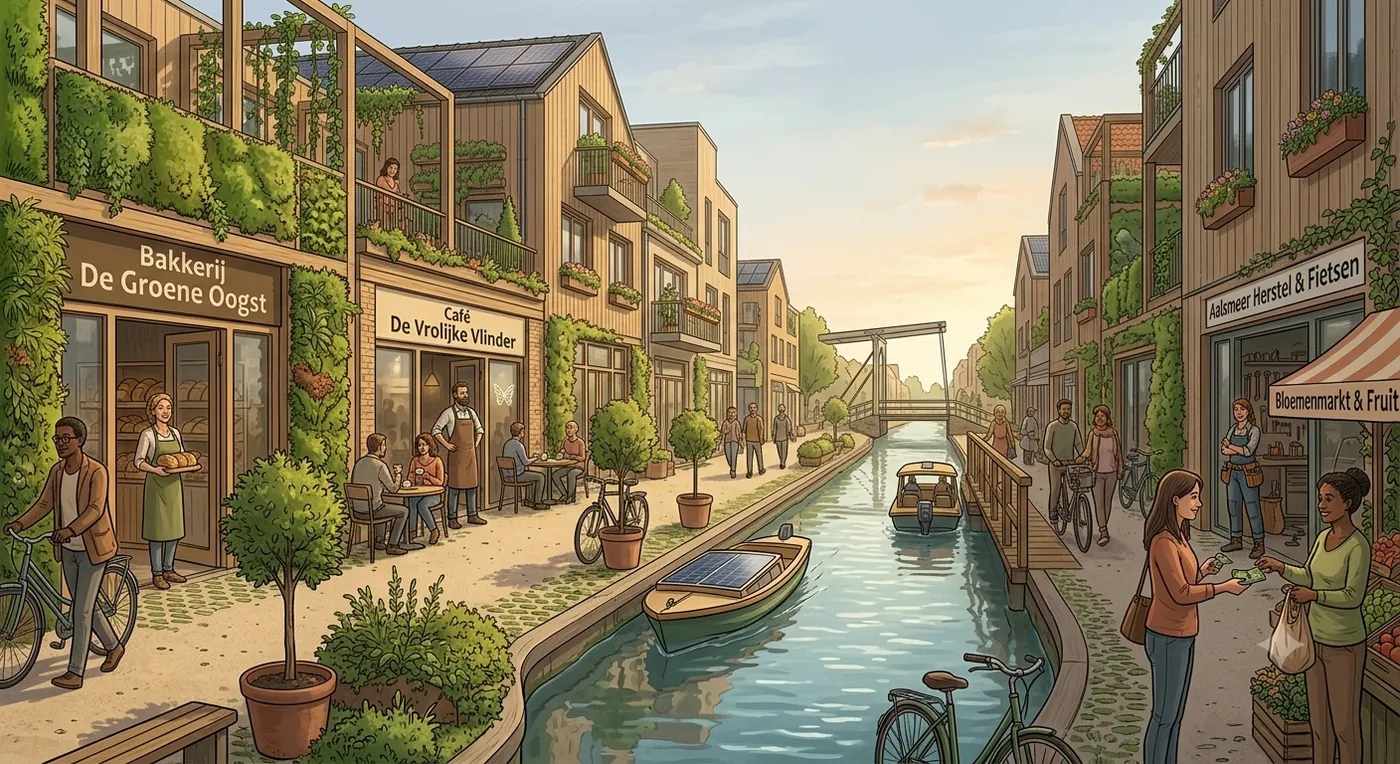
Lively car-free shopping street with a bakery, repair shop and café, homes above the shops

This is no moneyless utopia. People start businesses, make a profit and trade in ordinary euros. A business leases its space from the community, at a stable rent instead of a speculator doubling the price, and owns everything else itself: the shop, the brand, the profit.

So yes, you can get rich here. Money just cannot buy a few things: the finest home (that takes effort), political power (the democracy is not for sale), priority in care or education (free for all) and land (collective). The drive to build a business stays, the ways wealth warps a city disappear.

The commons are largely paid from the land itself: because the community owns all the ground, rising land value flows to everyone, and taxes on work and enterprise can stay low. Tax the land and the polluter, not the working person.

This is the heart of the idea.

And what about your data and your privacy in a city like this? That is the digital side of the story.

To The digital city